The City Was Always There
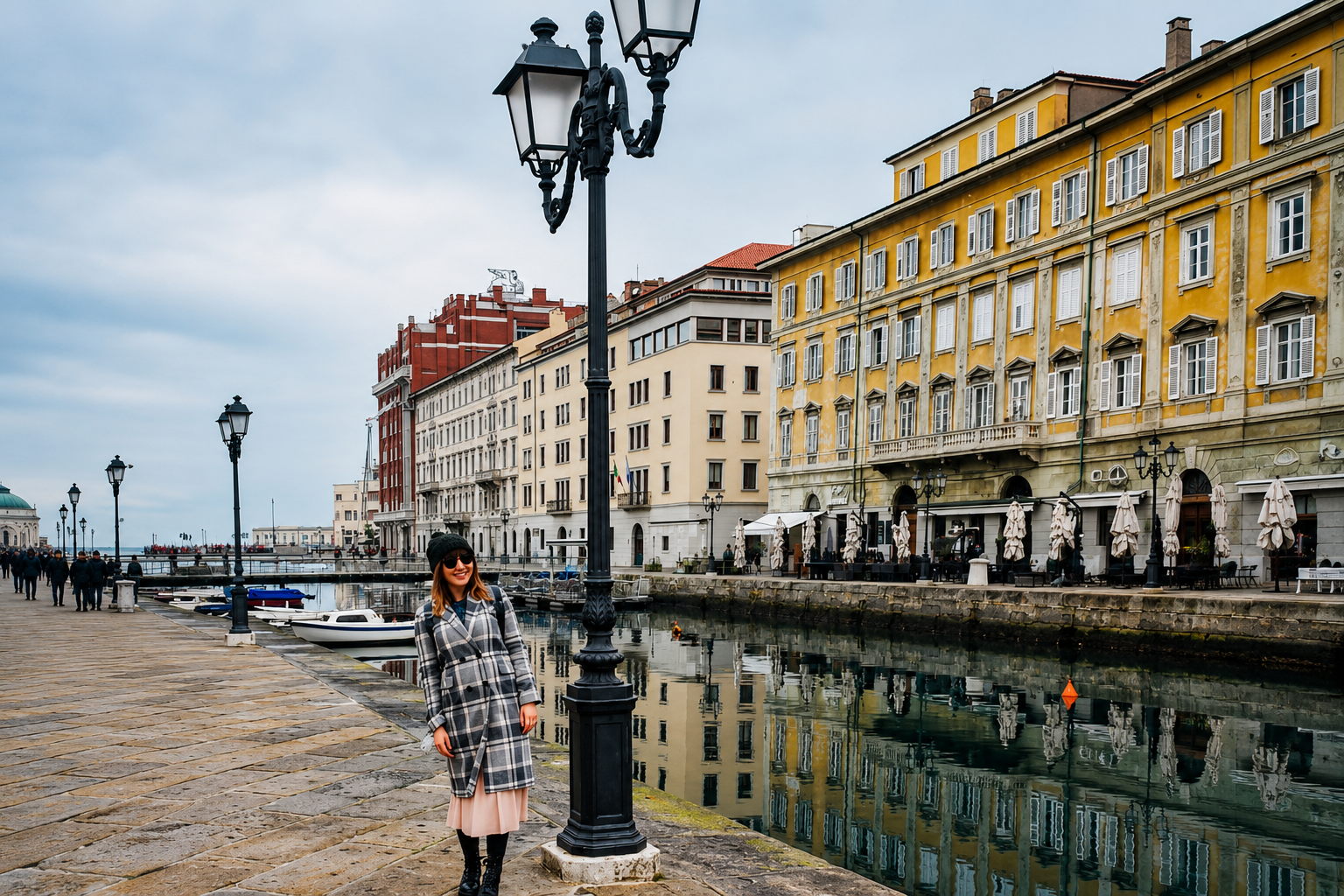
It’s late autumn. Enrico and I are sitting at lunch somewhere in Piazza Cavana. The table is too small, the plates are too big, and the wind always finds a way to slip under my coat no matter how I sit, because the Bora doesn’t care that it’s lunchtime.
A year ago, all of this would have annoyed me.
We’ve just come out of a year where everything felt slightly out of control: moving, apartments, unpacked boxes, a wedding, his bar exam, my master’s.
As we’re talking, at one point I hear my own voice. I mean, I hear it every day, but this time it felt like I actually heard myself. Is that really me — speaking Italian and sitting on the most charming piazza in the city?
And then the thought crosses my mind.
I’ve been here for six years, and apart from the initial excitement, it’s like I never really understood where I was living.
I thought the problem was the city. Trieste didn’t make sense to me, at least not in the way I expected it to.
Back home things worked, or at least I understood how they didn’t.
Life here always required negotiation:
opening hours that felt more like a suggestion,
offices where no one seemed to be in a hurry except me,
social circles that don’t open up just because I showed up.
In my head, I was constantly comparing.
Back home you can do this. Back home people are like that. Back home things are “normal”.
“Normal” actually meant: familiar, predictable, mine. I kept comparing belonging, and of course I kept losing. Here, I didn’t belong — and at first I didn’t even see it. For me, it was much easier to say the place was “inefficient” than to admit to myself that “I still don’t know how to exist here”.
It wasn’t that the city rejected me or that people didn’t accept me — they just didn’t notice me, and somehow that felt even worse. Because how do you fight invisibility?
When I was getting ready to move to Trieste, I thought my arrival would look like a movie scene: sun, sea, Italian conversations I magically understand, me becoming a slightly better version of myself just by being here. Reality was different, and not exactly chic: in my head I was translating every sentence before saying it out loud, so I would leave conversations exhausted instead of fulfilled, and the hardest part was accepting that everyone already had lives that didn’t include me.
In this new city, no one was waiting for me, and that was not part of my fantasy.
Enrico is from Trieste, so that helped — but not in the way I expected.
He didn’t “open the city” for me, he just… didn’t struggle. He taught me when to wait, when not to insist, when “later” actually means later, and when it means never. In my previous world, that looked like passivity, and only later did I understand that it was a kind of fluency — not linguistic, but life fluency.
There was no single moment when I suddenly started thinking and living differently.
I believe the change happened gradually, through many small moments that showed me things would be okay if I loosened up a bit. It happened in small things — the first time something took longer than it “should” and I didn’t get annoyed, or when I down a coffee at the bar standing up. In any case, I’m still learning to stop trying to win arguments no one else is even having.
In the past few months, I’ve been walking a bit slower, looking around more. Trieste hasn’t changed: the same squares, the same sea, the same wind. I stopped expecting the city to adapt to me. I’m learning how to exist within it, because belonging is something you stop resisting.
I finally started looking it in the eyes.
← Back to the Journal
hej